- Home
- Countertops
- Products
- Gallery
- Customer Testimonials
- Design Simulator
- Resources
- Contact


When homeowners compare countertop materials, they usually start with the stone itself. They look at color, pattern, price, and whether quartz or granite makes more sense for their kitchen or bathroom. That is important, but the finish matters too.
A countertop’s finish affects how it reflects light, how it feels to the touch, and how it looks during everyday use. Polished, honed, leathered, and other finish types can make the same material feel very different. Here is a practical look at the most common countertop finish types for quartz and granite, and how to decide which one fits your home.
A countertop finish is the final surface treatment applied to the slab. It changes the sheen, texture, and overall appearance of the material without changing the core material itself.
In simple terms, the finish helps determine whether the surface looks glossy or soft, smooth or textured, bold or understated. It also affects what stands out during daily use. On one finish, fingerprints may be more noticeable. On another, crumbs or wipe marks may stand out more.
A finish can impact:
Quartz countertop finishes often depend on the brand, color, and product line. In many cases, quartz is available in polished finishes, with honed, matte, or textured options in select colors.
Polished quartz is the finish most homeowners picture first. It has a glossy surface that reflects light, giving the countertop a clean, bright appearance. This finish can make veining and color contrast appear more defined, which is one reason it remains so common in kitchens and baths.
From a daily-use standpoint, polished quartz is usually straightforward to wipe down because the surface is smooth. At the same time, that reflective finish may make smudges, fingerprints, or streaks easier to notice, especially in kitchens with strong overhead lighting or large windows.
Quick takeaway:
Look: glossy and reflective.
Works well for: brighter kitchens, easy wipe-down routines
Consider if you notice fingerprints easily.
Honed or matte quartz has a lower-sheen surface that feels softer to the eye than polished quartz. It often works well in modern kitchens or spaces where homeowners want a quieter, less reflective look.
This finish can create a calm, understated appearance, but it is worth knowing that some matte surfaces may show wipe marks or areas of oil sheen depending on the color and product. Availability can also vary widely by manufacturer, so not every quartz design will come in a matte finish.
Quick takeaway:
Look: matte to low sheen.
Works well for: softer, less reflective kitchens
Consider if you prefer a calmer surface.
Some quartz products are offered in textured finishes such as suede, concrete, or other soft-touch surfaces. These finishes are designed to add a little more tactile character and reduce glare, making quartz feel closer to natural stone.
Textured quartz can be visually interesting, especially in contemporary kitchens. However, because the surface is not as slick as polished quartz, it may hold onto very fine crumbs a little more, which can mean slightly more attention during cleanup. These finishes are also often limited to specific colors rather than full product lines.
Quick takeaway:
Look: low sheen with light texture.
Works well for: design-forward kitchens
Consider if you want less glare and a more tactile feel.
Granite is a natural stone, so finish options are often broader than what you will find with quartz. The same slab can take on a very different personality depending on whether it is polished, honed, leathered, or brushed.
Polished granite is the most traditional and widely recognized granite finish. It has a glossy surface that deepens color, sharpens pattern contrast, and highlights the stone’s natural movement.
Many homeowners choose polished granite because it feels familiar and is simple to wipe down day to day. Still, like polished quartz, it may show smudges or water marks more clearly under direct light, especially on darker colors.
Honed granite has a matte to satin appearance. It softens reflection and can give natural stone a more relaxed, understated look.
This finish appeals to homeowners who want granite without the polished sheen. Depending on the stone and its use, honed granite may develop a patina over time. Sealing guidance and day-to-day habits matter here, since natural stone performance can vary from slab to slab.
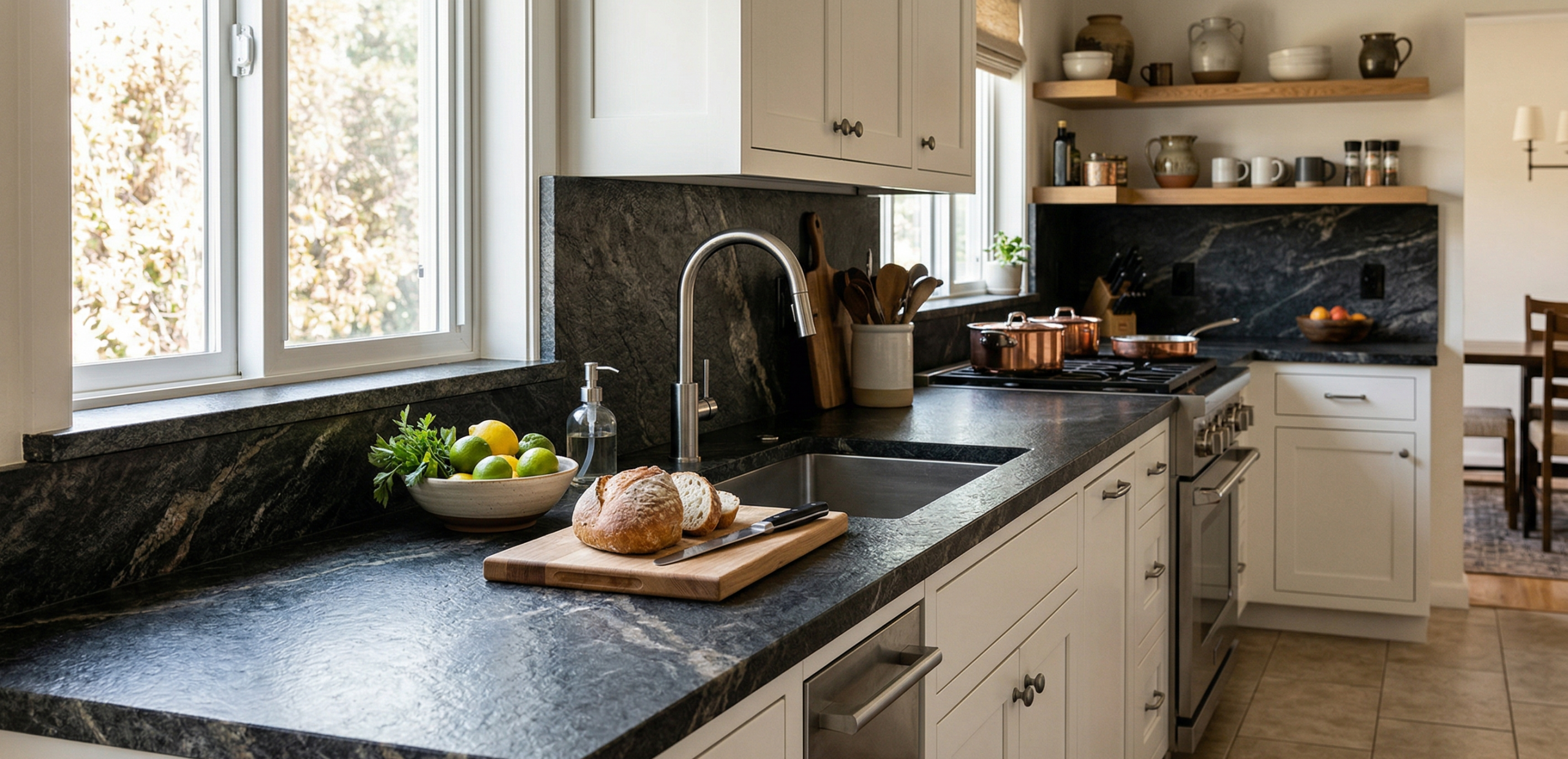
Leathered granite has a textured surface with low sheen. It retains some of the stone’s natural variation while adding a more tactile finish that many homeowners describe as warm or organic.
One reason leathered granite countertops get so much attention is that they often hide fingerprints and water marks better than polished surfaces. That can be helpful in busy kitchens. The trade-off is that, because the surface has more texture, wiping away crumbs may take more care than on a fully polished slab.
Brushed and antiqued granite finishes fall into a similar family as leathered finishes, though the exact appearance can vary. Some look gently weathered, while others have more noticeable texture or a slightly aged character.
These finishes can have a strong design impact, particularly in kitchens that lean toward rustic, transitional, or natural styles. Availability varies, and the look can differ quite a bit from one stone to another, so seeing larger samples in person is especially important.
A less common option is flamed granite, which has a rougher finish and is usually used outdoors. It is not as common for interior kitchen countertops.
The right countertop finish depends on what you want to see and feel every day, not just what looks good in a small sample.
A few general patterns can help:
The easiest way to narrow your options is to think beyond the showroom label and picture how the countertop will function in your home. A polished surface may make a kitchen feel brighter, but if you are sensitive to fingerprints or streaks, that same finish may not feel as practical once the space is in use.
It also helps to think about how often the room is used and who uses it. A busy family kitchen has different demands than a guest bathroom. Some homeowners are comfortable with a little maintenance or natural variation, while others want the simplest possible cleaning routine.
Style matters too, but it should not be the only factor. A finish that looks appealing in a photo may feel very different in person once you see how it responds to light, how it shows marks, and how it feels under your hand.
Use this checklist as you compare samples:
In Pittsburgh-area homes, lighting conditions can vary a lot, especially in older homes where kitchen layouts and window placement are less uniform. That can change how reflective or muted a finish appears in real life. Water spotting may also appear differently depending on the finish and color, which is one reason it helps to compare larger samples under lighting similar to that in your home.
Sometimes, but it depends on the material and the finish involved. Natural stone may be refinished in some cases by a skilled professional, while engineered quartz is generally not something homeowners should expect to refinish after installation.
Not necessarily harder, but it can be a little different. Leathered granite often hides fingerprints and watermarks well, though small crumbs may require a bit more attention because of the texture.
The finish itself does not automatically mean a countertop will stain, but honed surfaces can show use differently than polished ones. With natural stone, sealing and routine care still matter.
In many cases, lower-sheen or textured finishes are more forgiving. Leathered granite and some matte or textured quartz options may make fingerprints and water marks less noticeable than polished surfaces.
No. Quartz countertop finishes often depend on the manufacturer and color line, and granite availability can also vary by slab and supplier. That is why it helps to ask about finish options early in the selection process.
Look at larger samples rather than small chips whenever possible. Pay attention to sheen, texture, how the color reads under light, and how easily you notice smudges, streaks, or pattern detail from different angles.
The finish is a major factor in how a countertop will look and feel once installed. It affects shine, texture, visibility of daily marks, and the overall mood of the room. That is true whether you are comparing quartz countertop finishes, granite countertop finishes, or deciding between polished vs honed countertops.
The most reliable way to choose is to compare larger samples in person under lighting that resembles your home’s. If you are planning a kitchen or bath update in the Pittsburgh area, visit the Lexmar USA showroom to compare countertop finish types side by side, or request a quote and get help narrowing down the finish that fits your space and routine.

Lexmar USA refers its customers to the following quality lender for their financing.
Click here for more details and enter Promo Code: 0038-3729