- Home
- Countertops
- Products
- Gallery
- Customer Testimonials
- Design Simulator
- Resources
- Contact


Commercial countertops need to balance appearance, durability, cleanability, maintenance, budget, and installation logistics. In restaurants, bars, cafes, coffee shops, breweries, bakeries, hotel dining areas, and similar spaces, countertops are part of daily operations. They handle spills, frequent cleaning, customer interaction, equipment placement, moisture, and heavy use.
That makes restaurant, bar, and cafe countertops different from residential surfaces. The right choice depends on how each area will be used, how visible it is to customers, and how much maintenance the business can realistically manage.
Granite, quartz, solid surface, and countertop remnants can all be practical options for commercial spaces. As a Pittsburgh countertop fabricator, Lexmar USA helps businesses compare materials, plan fabrication details, and complete professional countertop installation for commercial projects.
Commercial countertops face frequent use, spills, moisture, impact, cleaning, and customer visibility. A front bar may need a different material than a coffee counter, host stand, bathroom vanity, back bar, prep-adjacent surface, or retail display counter.
There is no single best material for every project. The right choice depends on traffic level, appearance goals, maintenance expectations, budget, installation conditions, and project requirements.
Before choosing restaurant countertop materials, consider:
Durability, stain resistance, moisture resistance, cleaning requirements, heat exposure, visual style, seam placement, edge profile, repairability, project timeline, and long-term maintenance.
Fabrication details also matter. Countertop seams, sink openings, faucet holes, equipment cutouts, overhangs, and support planning should be reviewed before fabrication begins.
Granite countertops are natural stone surfaces with unique colors, movement, and pattern variation. Because each slab is different, granite can be a strong choice for customer-facing areas where appearance and durability both matter.
Common commercial uses include bar tops, reception counters, host stands, cafe service counters, restaurant bathroom vanities, and accent surfaces. Granite can create a more custom look for restaurants, bars, breweries, hotels, and hospitality spaces.
Granite offers a natural stone appearance with a strong visual impact. It is available in many colors and patterns, which gives owners and designers flexibility when matching the countertop to the space.
When properly fabricated, supported, sealed, and maintained, granite can work well in commercial areas that need both durability and style. It is especially useful for bar countertops, host stands, and other customer-facing surfaces.
Natural variation means slabs should be selected carefully. Color, veining, and pattern can vary from one slab to another, so it is important to review the material before final approval.
Granite may also require sealing and specific care, depending on the stone and its use. Heavy slabs require proper support, and seams and edge profiles should be planned before fabrication.
For commercial granite countertops, working with a countertop fabricator in Pittsburgh helps ensure the material, edge, sink openings, and installation plan are coordinated.
Quartz countertops are engineered stone surfaces known for consistent colors and patterns. They are popular in commercial spaces where predictable appearance and low-maintenance countertops are priorities.
Quartz can work well for cafe counters, service counters, bathroom vanities, bar tops, retail display areas, hotel dining counters, and hospitality spaces.
Quartz offers a consistent appearance, which can be helpful for businesses seeking a clean, coordinated look across a single location or multiple properties. It is available in many colors and design styles, including options that resemble natural stone.
Quartz is also nonporous and does not require sealing like granite. This makes low-maintenance quartz countertops a practical option for many customer-facing food service countertops.
Quartz is durable, but it should not be treated as indestructible. Heat exposure should be considered, especially near hot equipment or areas where hot items may be placed. Manufacturer guidelines should always be reviewed.
Large layouts may still require countertop seams, and those seams should be planned carefully. Sink openings, faucet holes, equipment cutouts, edge profiles, support needs, and installation conditions should also be discussed with the fabricator and project team.
Solid surface countertops are man-made surfaces often used where smooth transitions, easy cleaning, and repairability matter. They can be a practical fit for cafe counters, service counters, commercial restroom vanities, healthcare or office-adjacent food service areas, and certain back-of-house or utility surfaces, depending on use.
Solid surface can also support a clean, seamless-looking design. In some applications, integrated sink options may be available, which can be useful for restroom vanities or service areas.
Solid surface offers a smooth appearance and broad design flexibility. It is available in many colors and patterns, making it adaptable to a range of commercial interiors.
It is also repairable in many cases, depending on the type of damage and the material. This can be helpful in high-use areas where long-term appearance is important. Solid surface may be a good fit for commercial restrooms, service counters, and areas where integrated sinks or smooth transitions are desired.
Solid surface may not have the same natural stone appearance as granite. It can also be affected by heat or sharp objects, so the material should be matched carefully to the specific commercial use.
Before installation, owners should discuss maintenance expectations, cleaning routines, and manufacturer care guidelines with their countertop fabricator.
Different areas may call for different countertop materials. A single restaurant or cafe may use quartz for a service counter, granite for a bar top, solid surface for a restroom vanity, and remnants for smaller accent areas.
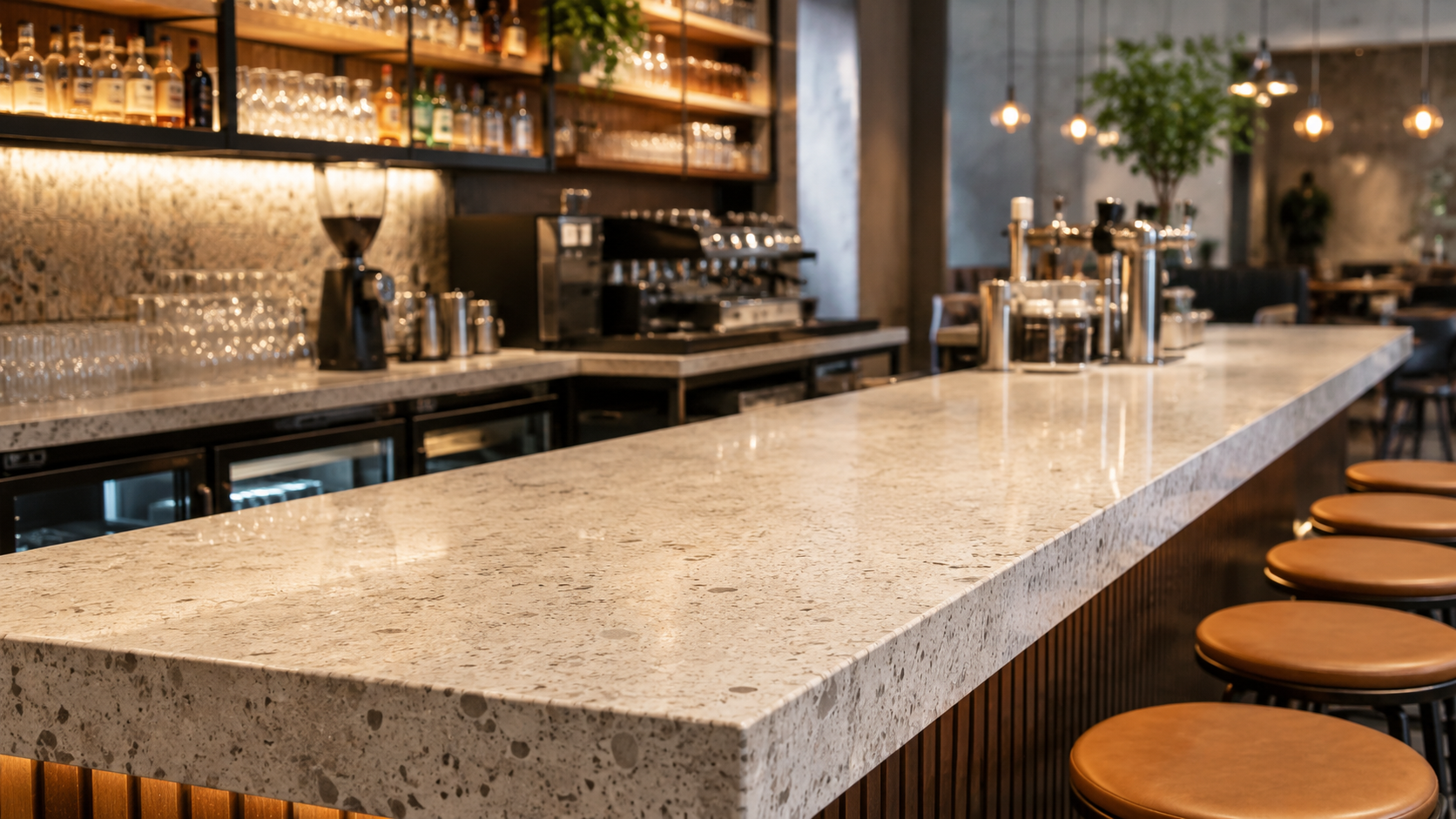
Bar top materials need to be durable, moisture-resistant, visually appealing, and feature carefully planned seams. Granite and quartz may both be strong options depending on the desired appearance and maintenance expectations. Edge profile matters because customers interact directly with the bar.
Cafes and coffee counters deal with spills, daily cleaning, equipment placement, and customer visibility. Quartz or solid surface may be practical. Openings for sinks, equipment, dispensers, or accessories should be planned early. Sink and faucet cutouts are especially important for cafe counters, bars, and service areas.
Host stands and reception counters help shape the customer’s first impression. Granite, quartz, or remnants may work depending on size, design, and budget.
Commercial bathroom vanities need moisture resistance and cleanability. Quartz, granite, solid surface, or remnants may all be considered. Integrated sink options point toward solid surface in some applications.
Back bars and service stations should be selected based on durability, maintenance, moisture exposure, equipment placement, and workflow. The best material depends on how the area will be used every day.
Commercial countertop fabrication involves more than material selection. Details such as seams, edges, cutouts, support, and installation planning affect how the surface looks and performs.
Larger commercial runs may require seams. Countertop seams should be placed intentionally for appearance, strength, and usability. Bar tops, long counters, corners, and L-shaped layouts all need careful planning.
Countertop edge profiles affect appearance, comfort, and durability. High-contact areas may benefit from practical edge choices that are comfortable for customers and staff.
Commercial counters may need openings for sinks, taps, equipment, dispensers, trash openings, or other fixtures. These details should be finalized before fabrication. Your contractor, designer, or local authority can confirm project-specific requirements where applicable.
Bar tops and customer seating areas may include overhangs. Support should be planned based on material, thickness, layout, use, and project requirements. The project team should confirm structural details.
The right countertop material should match the business’s maintenance routine. Owners and managers should consider daily cleaning, spill exposure, sealing, heat, impact, and repair expectations.
Granite may require sealing and specific care. Quartz is low-maintenance but still requires proper use and cleaning. Solid surface may be repairable in many cases, but should be protected from heat and sharp objects.
Ask about the manufacturer’s care guidelines before installation, so staff understand the recommended cleaning and maintenance routine.
Lexmar USA helps restaurants, bars, cafes, coffee shops, breweries, bakeries, hotels, and commercial property teams plan countertop projects in the Pittsburgh area. Through commercial countertop fabrication, Lexmar can help evaluate material options, layout, edge profiles, sink and fixture cutouts, seam placement, support needs, and installation planning.
For businesses looking for commercial countertops in Pittsburgh, Lexmar USA can help plan the project from material selection through fabrication and installation. Whether the project involves restaurant and bar countertop projects, cafe countertops, bathroom vanities, or smaller countertop projects using remnants, the goal is to choose a surface that fits the space and daily use.
Planning a countertop project for a restaurant, bar, or cafe? Lexmar USA can help you choose the right material, plan fabrication details, and complete professional countertop installation for your commercial space. Request a commercial countertop estimate to get your countertop project started.
There is no single best material for every restaurant. Granite, quartz, and solid surface can all work well depending on the use, appearance goals, maintenance expectations, and project requirements.
Quartz can be a practical choice for many restaurant, cafe, and hospitality surfaces because it offers consistent design options and low maintenance. Heat exposure, seams, and manufacturer guidelines should still be considered.
Yes. Granite can be a strong option for bar tops and customer-facing counters when it is properly fabricated, supported, sealed, and maintained.
Solid surface can be a good fit for commercial restrooms, service counters, and areas where a smooth appearance or repairability is important. The right fit depends on how the surface will be used.
Yes. Remnants can be useful for smaller commercial areas such as bathroom vanities, host stands, side counters, or small cafe surfaces, as long as the available piece fits the project requirements.
Material selection, sink openings, faucet holes, equipment cutouts, seams, edge profiles, overhangs, and support should all be reviewed before fabrication begins.

Lexmar USA refers its customers to the following quality lender for their financing.
Click here for more details and enter Promo Code: 0038-3729